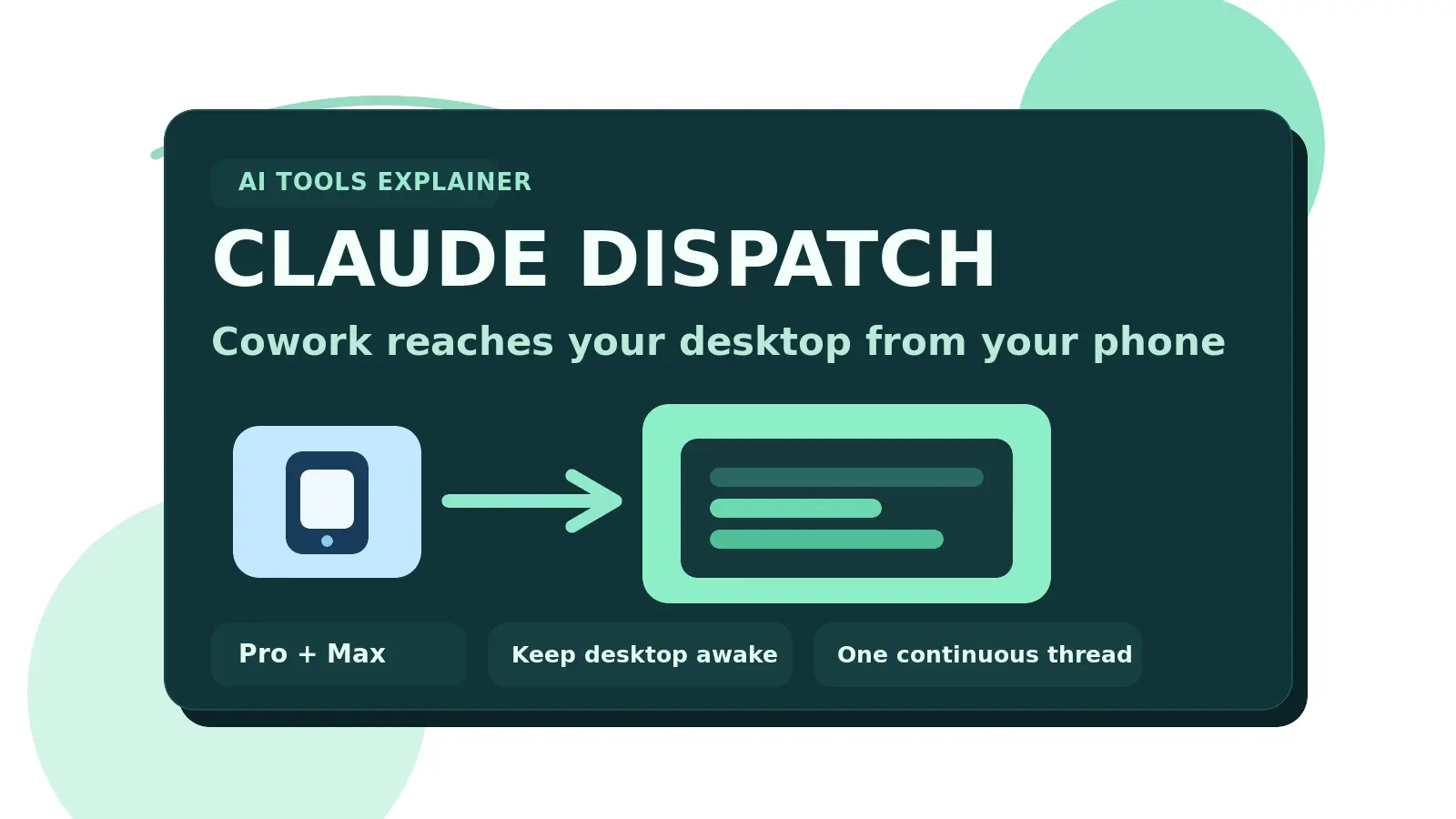
Claude Dispatch is the first Anthropic feature that makes desktop Claude feel like a real remote assistant instead of a powerful tool chained to one chair. When I checked Anthropic's support docs on March 19, 2026, the practical question was simple: does Dispatch actually let Claude keep a Cowork workflow alive from your phone, or is it just another mobile wrapper? The short answer is that it is real remote reach. Anthropic now gives Pro and Max users one continuous Cowork conversation across phone and desktop, and Claude keeps working on your own computer with the files, connectors, and plugins you already allowed. But it is still tied to one awake desktop, one thread, and a permission model you need to treat seriously.
What Does Claude Dispatch Actually Do?
Anthropic's official Dispatch article is clearer than the feature name.
Dispatch sits inside Cowork and gives you one persistent conversation with Claude that you can reach from either your phone or your desktop. Claude does not shift the work into some separate mobile environment. It keeps running on your desktop computer, using the same local access, connectors, and plugins already configured in Cowork.
This is the fastest way to understand it:
| Dispatch capability | What Anthropic says | Why it matters |
|---|---|---|
| One continuous conversation | Dispatch gives you one continuous conversation reachable from phone or desktop | Mobile is not a separate chat silo |
| Desktop execution | Claude works on your computer, with the access already granted in Cowork | Your phone becomes the control surface, not the runtime |
| Guided setup | Setup includes toggles for file access and keeping your computer awake | Anthropic is making the local-machine dependency explicit |
| Paid rollout | The feature requires a Pro or Max plan and the latest desktop and mobile apps | This is not a free add-on and rollout timing matters |
That last point is important. When I checked the help article, Anthropic said the research preview was rolling out gradually to Max plans first and Pro plans next, and that both the desktop app and mobile app needed to be updated before the feature would appear.
Does Dispatch Finally Fix the Desktop-Agent Tether Problem?
Mostly, yes.
Cowork already mattered because it brought Claude Code's agentic behavior into Claude Desktop for work beyond coding. Anthropic says Cowork can handle local files, connectors, plugins, sub-agents, scheduled tasks, and longer-running tasks in a desktop VM. What Dispatch changes is the mobility of that workflow.
Before Dispatch, Cowork could keep running while you stepped away from the keyboard, but the experience was still anchored to the machine in front of you. Dispatch removes that "stay near the desk" requirement by letting you assign or follow up on the same task from your phone.
That makes Claude feel closer to a remote operator than a demo you babysit.
It is still different from Claude Code on the web, though. Anthropic's web product runs coding tasks in remote environments tied to GitHub repositories. Dispatch is the opposite model: the execution environment is your own desktop session, which is exactly why it can work with local files and personal setup, but also why it inherits your desktop's limitations.
What Can Claude Reach From Your Phone?
The right mental model is not "Claude on mobile gets everything."
It is "your phone can now reach whatever Cowork on your desktop can already reach."
According to Anthropic's help articles, that can include:
- local files you explicitly allowed Claude to access
- connectors and plugins already configured in Cowork
- Claude in Chrome and broader web access, if you enabled those capabilities in your Cowork setup
- ongoing tasks that produce files, reports, presentations, spreadsheets, and organized folders on your desktop
Anthropic's own examples are practical, not futuristic. The Dispatch article highlights work like pulling data from a local spreadsheet, searching connected tools such as Slack or email, building a presentation from Drive files, or organizing a folder on your computer.
That is why this feels like a category shift. The phone is no longer just the place where you ask questions. It becomes a remote handle for the environment where the work actually happens.
What Are the Biggest Limitations Right Now?
Anthropic is explicit that Dispatch is still a research preview, and the current limits matter enough that they should shape expectations up front.
| Limitation | What it means in practice |
|---|---|
| Your desktop must stay awake | If your computer sleeps or Claude Desktop closes, the task stops |
| One continuous thread | There is no clean multi-thread or project-by-project separation yet |
| No completion notifications | You still have to check back instead of waiting for a proactive alert |
| No scheduled tasks in the Dispatch thread | Scheduling exists elsewhere in Cowork, but not inside this one continuous mobile-linked thread |
That single-thread design is the biggest product risk in day-to-day use. Anthropic states the limitation directly. The likely consequence, which is my inference from the product structure, is that a heavily used Dispatch session can get messy over time because unrelated work keeps accumulating in one running context.
So Dispatch is a real upgrade, but it is not yet a clean "personal AI operating system" in the full sense. It is a better remote control layer over one ongoing Cowork session.
Why Safety Is the Real Story
Anthropic's safety guidance is one of the strongest parts of this release because it does not pretend the risks are theoretical.
The company explicitly warns that mobile access extends whatever file, connector, plugin, and browser-related permissions you have already granted on desktop. Anthropic also warns about prompt injection, phishing pages, malicious instructions, and unsafe file access. In plainer terms: once your phone can trigger work on your desktop agent, the convenience is real, but so is the blast radius.
The support docs do point to real guardrails:
- deletion protection requires explicit approval before permanent file deletion
- Anthropic says untrusted content is scanned for injections
- Cowork's default internet access is intentionally restricted
- the company advises users to limit Claude in Chrome and broader web access to trusted sites only
That said, Anthropic also states that attack risk is still non-zero and that you remain responsible for Claude's actions on your behalf.
That is the correct framing. Dispatch is exciting because it crosses from assistant into delegate. The moment you reach that threshold, permission hygiene stops being optional.
Why Pricing and Usage Will Matter If Dispatch Sticks
This is the part people should watch after the launch excitement fades.
Anthropic's official plan docs currently put Pro at $20/month, Max 5x at $100/month, and Max 20x at $200/month for web subscriptions. The Cowork docs also say Cowork consumes more usage than standard chat because these tasks are more compute-intensive and multi-step. Max and Pro plans both still have usage limits, and Anthropic says it may apply additional weekly or monthly caps depending on demand and feature usage.
The company does not frame Dispatch as an economic problem. That next conclusion is my inference from Anthropic's own pricing and usage docs. If mobile-to-desktop agent workflows become routine knowledge-work infrastructure, then pricing discipline will matter just as much as capability. A feature like Dispatch can feel magical at low friction and much less magical if users constantly hit plan boundaries.
So the long-term question is not only "Does this work?" It is also "Can this remain usable at a price and usage model that people accept as normal?"
The Bigger Takeaway
Dispatch does not turn Claude into a free-floating autonomous cloud worker. It does something more specific and, in some ways, more interesting: it makes a live desktop agent reachable.
That sounds modest until you notice what it unlocks. Once a language interface on your phone can trigger real work inside your own desktop environment, the product stops feeling like mobile chat and starts feeling like remote delegation.
That is why this matters. Not because Dispatch is perfect today. It is not. But because it shows a more serious direction for AI tools: persistence, action, cross-device continuity, and guarded autonomy inside real user environments.
If you are tracking the bigger shift in developer and knowledge-work tooling, Will AI Replace Developers? Agentic Coding Changes the Job is the broader framing piece. For more articles in this lane, use the AI Tools hub.